
At some point, every growing business faces the same question: do we hire IT staff internally, or do we work with a managed IT services provider?
The framing makes it sound like a straightforward choice. In practice, it’s a decision with real financial consequences, security implications, and operational trade-offs that look different depending on the size and complexity of the business making it.
Neither model is universally better. But for most small and mid-sized businesses, the comparison reveals a meaningful gap between what in-house IT can realistically deliver and what the business actually needs and that gap is worth understanding clearly before making a decision.
What In-House IT Actually Means

An in-house IT model means hiring employees who work directly for the organization and manage technology internally. Depending on company size, this might be a single IT administrator, a small team, or in larger organizations a dedicated department with specialists across networking, security, and infrastructure.
The internal team handles everything: maintaining business technology, supporting employees, managing cybersecurity, keeping systems operational, and planning for future infrastructure needs.
For large enterprises with complex, highly customized environments, an internal IT department is often the right model. For smaller organizations, the math tends to look different.
What Managed IT Services Actually Mean
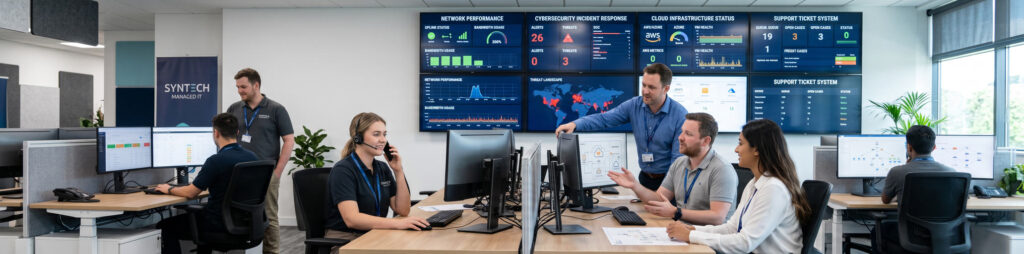
Managed IT services involve partnering with an external provider that proactively manages and supports your technology environment on an ongoing basis not just when something breaks.
A managed IT provider continuously monitors systems, handles maintenance, responds to issues, and provides strategic guidance as part of a fixed monthly agreement. The scope typically covers help desk support, network management, cybersecurity monitoring, cloud infrastructure, backup and disaster recovery, vendor management, and business continuity planning.
The model exists to give businesses access to a full range of IT expertise without the cost and complexity of building that capability internally.
The Real Advantages of In-House IT
Direct access and organizational familiarity. Internal IT staff know the business. They understand the workflows, the applications, the department-specific quirks, and the history of decisions that led to the current environment. For organizations with highly specialized systems or processes, that institutional knowledge has genuine value.
On-site presence by default. Some situations genuinely require someone in the building hardware failures, infrastructure installations, new equipment setup. An internal IT employee is there when needed without scheduling considerations.
Direct management and control. Organizations that require strict day-to-day oversight of technology operations may prefer dedicated internal staff they can direct and manage within existing HR structures.
The Real Limitations of In-House IT
The cost is higher than most businesses expect. A single experienced IT administrator in the Los Angeles area commands a salary of $65,000–$90,000 annually before benefits, payroll taxes, training, certifications, and the overhead costs of employment. That covers one person, during business hours, with one person’s range of expertise.
One person cannot cover everything modern IT requires. Today’s business technology environments demand expertise across cybersecurity, networking, cloud platforms, backup systems, compliance, endpoint management, and infrastructure. Expecting a single IT hire to be genuinely proficient across all of these areas creates a competency gap and that gap is usually where security incidents and operational failures originate.
Single point of failure. What happens when your IT employee takes vacation? Gets sick? Leaves for another position? Many businesses discover how dependent they’ve become on one individual only when that person becomes unavailable. The answer, in most cases, is that operations are more vulnerable than anyone realized and that the knowledge walking out the door is harder to replace than anticipated.
The Real Advantages of Managed IT Services
Access to a complete team across multiple disciplines. Rather than one person’s expertise, managed IT services provide access to professionals with specializations across cybersecurity, networking, cloud infrastructure, compliance, and business continuity. When a situation requires a specific skill set, the right person is available not whoever happens to be on staff.
Predictable, budgetable costs. Fixed monthly pricing allows businesses to forecast IT expenses accurately and avoid emergency support costs that arrive unplanned. For growing organizations managing budgets carefully, predictability has real operational value.
Proactive management instead of break-fix support. Traditional IT support waits for something to fail and then responds. Managed IT focuses on prevention — continuous monitoring catches hardware degradation, software instability, and security anomalies before they cause disruptions. According to CompTIA’s IT Industry Outlook, organizations that shift from reactive to proactive IT management report significant reductions in unplanned downtime within the first year.
Stronger cybersecurity coverage than most businesses can build internally. Cybersecurity is now a discipline in its own right threat monitoring, endpoint protection, vulnerability management, incident response, and employee security awareness training each require dedicated attention. Managed IT providers build these capabilities into their service model. Most small businesses cannot realistically replicate that coverage with a single internal hire.
24/7 availability. Managed IT providers offer around-the-clock monitoring and support. Internal staff work business hours, with everything outside those hours being either unmonitored or covered by an on-call arrangement that depends on one person’s availability.
The Real Limitations of Managed IT Services
Less default on-site presence. Most managed IT issues are resolved remotely, which is efficient and fast but some situations require physical presence. This is worth evaluating honestly when choosing a provider. A managed IT partner with local presence and on-site capability, like Techbleed serving businesses in Glendale and surrounding areas, addresses this concern directly.
Quality varies significantly between providers. Managed IT is not a standardized service. Response times, security capabilities, industry experience, and strategic guidance differ considerably from one provider to another. The right question isn’t whether managed IT services work it’s whether a specific provider has the depth to be a genuine technology partner rather than a help desk that answers tickets.
Which Model Fits Which Business

Small businesses (under 50 employees) typically need cybersecurity expertise, cloud support, network management, backup oversight, user support, and technology planning. Hiring enough internal personnel to cover all of these areas is financially impractical for most small businesses. Managed IT services provide those capabilities without requiring multiple full-time hires. Gartner research consistently shows that small businesses using managed IT services achieve better security outcomes and lower per-incident costs than comparable businesses managing IT internally.
Mid-sized businesses increasingly adopt hybrid models an internal IT coordinator or manager who understands the business deeply, supported by a managed IT provider for security operations, infrastructure monitoring, specialized projects, and strategic guidance. This combines internal familiarity with external depth.
Large enterprises typically maintain internal IT departments while partnering with managed service providers for specific functions: security operations, cloud management, compliance support, and business continuity planning. Even organizations with mature internal teams regularly rely on external specialists to fill capability gaps.
Questions Worth Answering Before Deciding
Before choosing a model, these questions tend to clarify the right direction:
How many employees does IT need to support and will that number grow significantly in the next two years? How critical is technology to daily operations, and what does an hour of downtime actually cost? Does the business handle sensitive data client records, financial information, healthcare data that creates compliance obligations? Could a single IT hire realistically cover cybersecurity, networking, cloud management, and user support competently? What happens to operations if the IT employee is unavailable for a week? What would a serious security incident cost the business financially and operationally?
The answers to those questions usually make the right direction clear without requiring a detailed analysis.
How Techbleed Helps Glendale Businesses Make This Decision
At Techbleed, we work with businesses in Glendale and the surrounding area that are evaluating whether managed IT services, internal IT resources, or a hybrid approach fits their operational needs and we’re straightforward about what makes sense for a given situation.
Our managed IT services include proactive monitoring and maintenance, cybersecurity protection, cloud infrastructure support, backup and disaster recovery, network management, 24/7 help desk support, business continuity planning, and strategic technology consulting. For businesses that already have internal IT staff, we work alongside them rather than replacing them.
The goal is a technology environment that operates reliably and securely however that’s best structured for the business it supports.
The Bottom Line
In-house IT and managed IT services are not competing philosophies they’re different tools suited to different situations.
For most small and mid-sized businesses, managed IT services offer broader expertise, stronger security coverage, 24/7 availability, and lower total cost than building a comparable internal team. For larger organizations or those with highly specialized environments, internal IT remains valuable often most effectively combined with external managed services for areas requiring dedicated depth.
The question worth focusing on isn’t which model sounds better in the abstract. It’s whether your current IT approach provides the reliability, security, and expertise your business actually needs and what it would cost if it doesn’t.