
Most small business owners don’t start looking for managed IT support because they want better technology. They start looking because something broke and it wasn’t the first time.
A server goes down during business hours. Employees can’t access files. The same Wi-Fi issue comes back for the third time this month. At some point, recurring IT problems stop being occasional inconveniences and start affecting how the business runs.
If you’re wondering whether your business has reached that point, these five signs are worth looking at honestly.
1. You Spend More Time Fixing IT Than Running Your Business

Technology should support your operations. When it starts consuming your attention instead, that’s a meaningful shift.
Think about the last month. How often did you or your team deal with slow computers, login issues, software errors, or connectivity problems? How many hours went into troubleshooting instead of serving customers or moving work forward?
Many small businesses start with an informal IT approach someone on staff who’s good with computers, or a technician who gets called when something breaks badly enough. This works until it doesn’t. The moment IT issues become a recurring part of the week rather than an occasional exception, the informal approach is costing more than it saves.
Managed IT services shift that dynamic. Instead of reacting to problems after they happen, your systems are monitored and maintained proactively so most issues get caught before they affect anyone.
According to CompTIA research, businesses that move from reactive to proactive IT management report significant reductions in unplanned downtime and support costs within the first year.
2. Your Business Is Growing Faster Than Your Technology
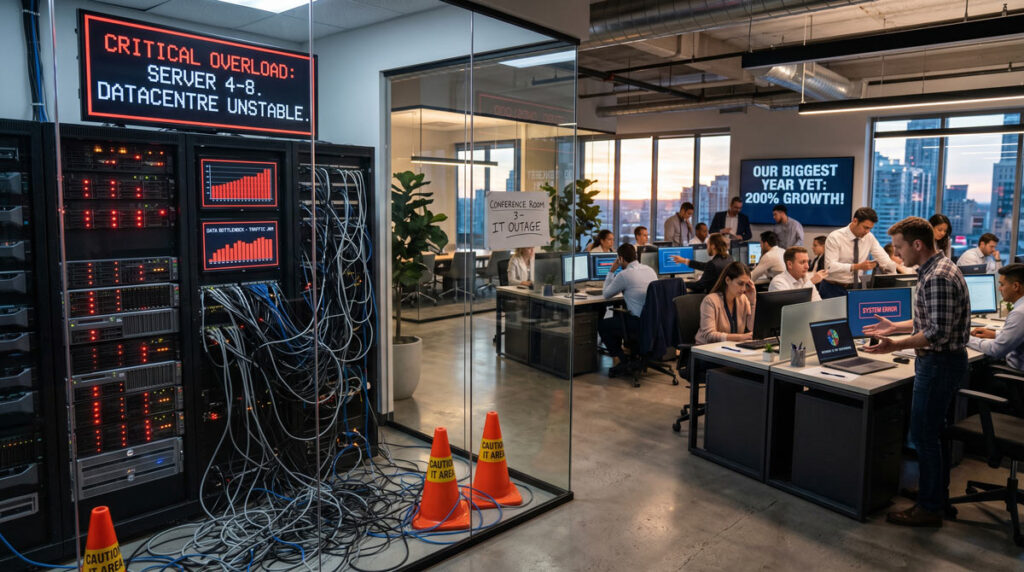
Growth creates technology demands that don’t always get addressed until they become problems. More employees mean more devices, more software licenses, more storage requirements, and a more complex network that needs to perform reliably for everyone using it.
What worked for a five-person team often starts showing strain at fifteen. Networks slow down. Onboarding new employees takes longer than it should. Systems that ran fine under lighter usage become inconsistent under heavier load.
The challenge is that infrastructure gaps rarely announce themselves clearly. They show up as performance issues that get blamed on individual devices, support requests that seem unrelated, and general friction that slows work down without anyone identifying the root cause.
A managed IT provider helps businesses plan infrastructure that scales with growth rather than becoming a bottleneck to it. The goal is technology that supports expansion instead of creating new problems each time headcount increases.
3. Cybersecurity Concerns Are Growing but You’re Not Sure Where You Stand

Small businesses are targeted by cyberattacks more often than most owners realize. Attackers focus on smaller organizations precisely because they typically have fewer security controls than larger enterprises and because the assumption that “we’re too small to be a target” means defenses are often weaker.
Phishing emails are now sophisticated enough to fool experienced employees. Ransomware regularly hits small businesses and can shut down operations for days. Remote work has expanded the attack surface for most organizations without a corresponding increase in security controls.
If you’re unsure whether your current setup adequately protects your business, that uncertainty is itself a signal. A business that knows its security posture is in a fundamentally different position than one that assumes it’s fine.
Managed IT services provide endpoint protection, security monitoring, access controls, backup systems, and employee security awareness training building a layered defense rather than relying on a single tool to do everything.
4. Downtime Is Starting to Affect Your Customers and Revenue

Every business has occasional technical issues. The problem is when downtime stops being occasional and starts being predictable and when the impact extends beyond internal inconvenience to customer experience and revenue.
An internet outage that prevents order processing. A server failure during peak hours. A software crash that takes two hours to resolve because nobody knows exactly what’s wrong. These aren’t just IT problems. They’re business problems with measurable costs.
Gartner estimates that IT downtime costs businesses an average of $5,600 per minute a figure that scales down for small businesses but remains significant relative to their size.
Managed IT support focuses on prevention first. Systems are monitored continuously, hardware degradation gets caught before it causes failures, and when something does go wrong, the response is fast because the environment is already understood.
5. Your Technology Has No Long-Term Plan

Many small businesses make technology decisions reactively a new computer when one fails, additional software when a team requests it, security tools after a concern surfaces. Over time, this creates a collection of disconnected systems that become progressively harder to manage.
The questions that reveal a planning gap are straightforward: Are your backups actually tested? When should aging equipment be replaced before it fails? Do you know which systems are most at risk? What happens to operations if a major outage occurs tomorrow?
If those questions don’t have clear answers, your business is managing technology reactively rather than strategically. That approach works until it creates an expensive problem and it usually does eventually.
Managed IT services provide ongoing technology guidance alongside technical support. A good managed IT partner helps you plan infrastructure decisions in advance rather than responding to failures after they happen.
Why Small Businesses Are Moving Toward Managed IT
Technology is now a core business function for most small companies not a supporting one. Cloud platforms, cybersecurity, remote work infrastructure, communication systems, and business applications all require consistent management to work reliably.
Managing all of that internally is expensive and difficult without a dedicated IT team. Managed IT services provide ongoing expertise, proactive monitoring, and predictable support at a fraction of the cost of hiring internally and without the coverage gaps that come with depending on a single person.
How Techbleed Helps Small Businesses in Glendale
At Techbleed, we work with small businesses that need IT to work reliably without the overhead of managing it themselves. Our managed IT services include proactive monitoring, cybersecurity protection, network management, cloud infrastructure support, backup and disaster recovery, and help desk availability around the clock.
If your business is experiencing any of the signs above, a free IT assessment is a practical first step we evaluate your current environment and give you an honest picture of where things stand.